![]() Sky Instance
#
Sky Instance
#
A sky instance describes the direct and diffuse, illuminance and irradiance in a sky for a location at a specific point in time. It is used for analyses like daylight factor, point in time illuminance and point in time irradiance to determine daylight and irradiance levels.
Sunlight#
The emission from the sky comes from the sun. This emission can be divided into a direct and a diffuse component and it can be measured either as energy or as light.
Direct#
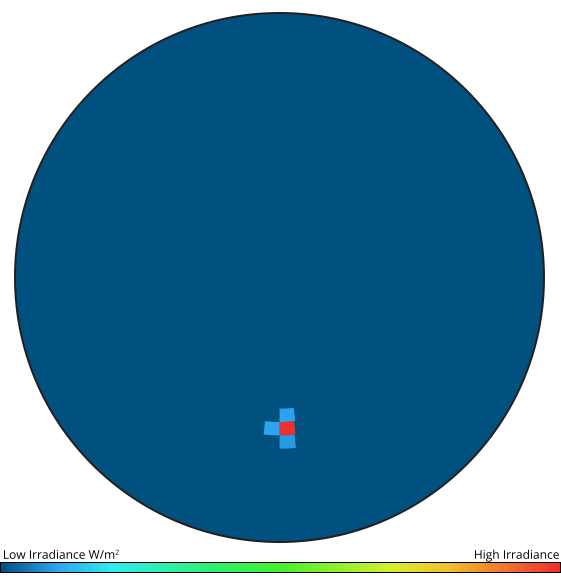
The direct component is the sunlight that is received directly from the solar disc. Cyclops uses a nearest neighbor method to distribute the direct component to the 4 closest patches in the hemisphere subdivision.

Diffuse#
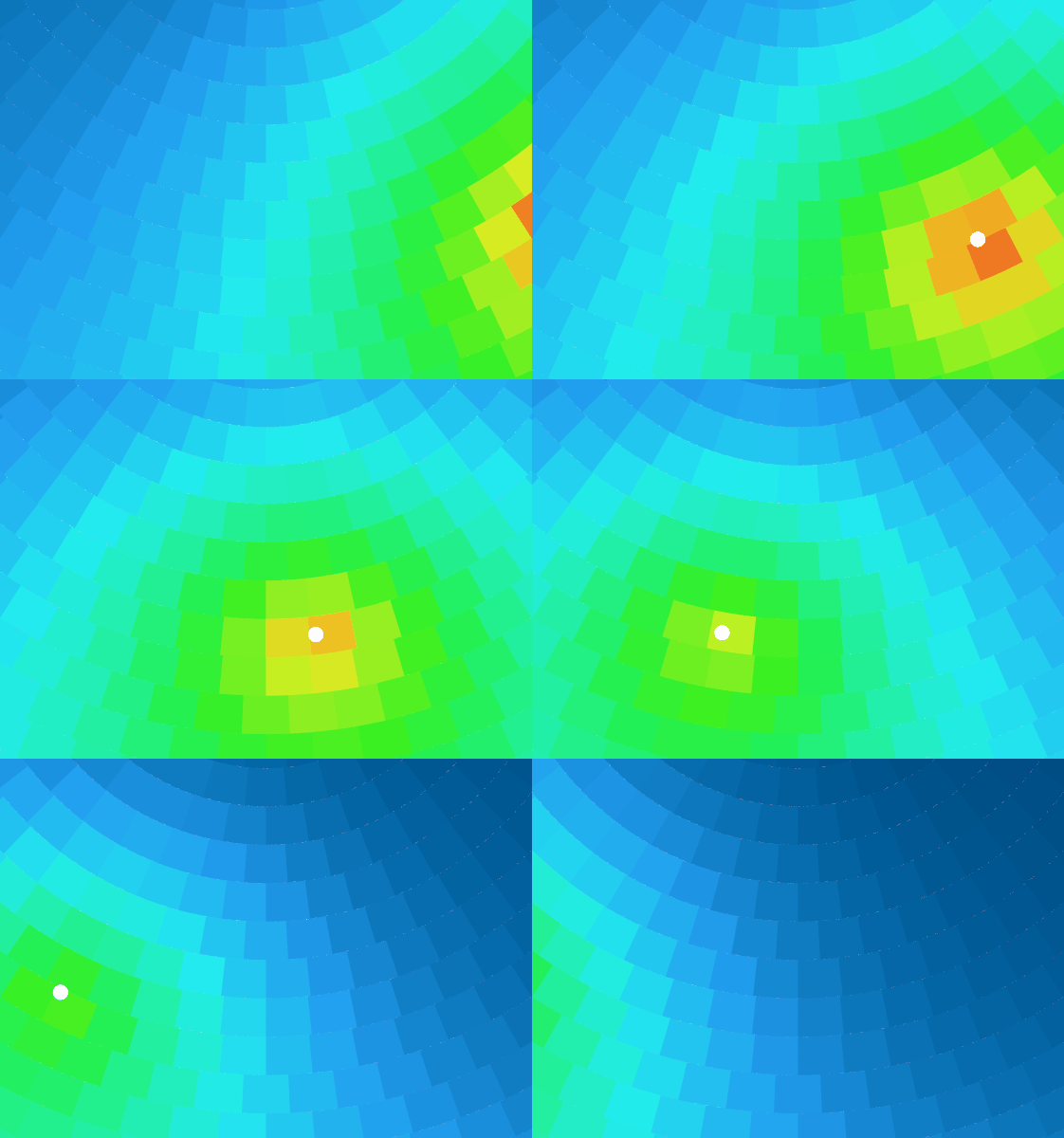
The diffuse component is the sunlight that is received from the sky outside of the solar disc, meaning the sunlight that has been reflected and scattered through the Earth's atmosphere before reaching the surface.
Irradiance#
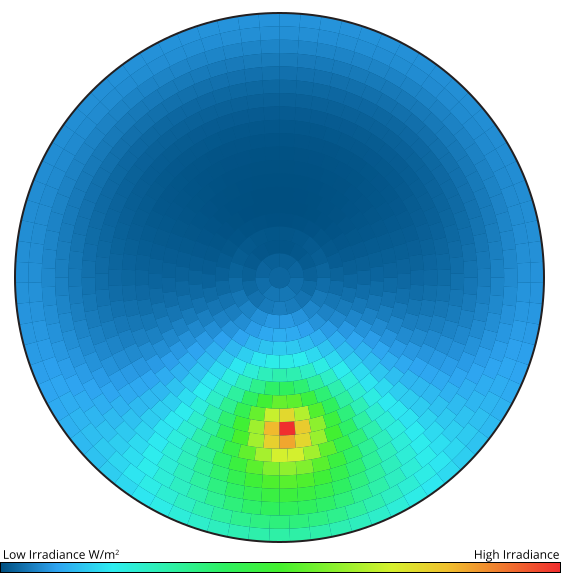
Each sky patch has a direct, a diffuse and a total irradiance component. This is the energy that is emitted from the specific patch measured in \(W/m^2\) which is used for radiation analyses.
Illuminance#
Each sky patch has a direct, a diffuse and a total illuminance component. This is the light that is emitted from the specific patch measured in \(cd.h/m^2\) which is used for daylight analyses.
Create Sky Instance#
A sky instance can be created using a few different constructors. Here are the generic inputs.
Hemisphere#
The hemisphere specifies the subdivision of the sky dome and thereby the amount of patches that should be used to describe the sky conditions. More patches produce a higher resolution and thereby a more accurate interpretation of the sky but more patches will lead to longer analysis times.
Ground Reflectance#
A value between 0 and 1 indicating the fraction of light that is reflected by an artificial ground plane. This is used to decide the contribution from parts of the lower hemisphere that are visible to the analysis.
Warning
It is still important to model ground and context to ensure valid results.
Luminance Components#
A filter that controls which components to include.
Direct and Diffuse#
Include both the direct light from the solar disc and the diffuse light scattered in the atmosphere.
Direct Only#
Include only the direct light from the solar disc.
Diffuse Only#
Include only the diffuse light scattered in the atmosphere.
Luminance Distribution Model#
A luminance distribution model is used to calculate the irradiance and illuminance contribution from each patch in the sky. There are two available models with slight differences. For a detailed breakdown of the equations behind them, Andrew Marsh provides an excellent overview in his article Sky Distribution Equations.
CIE Standard Sky Model#
The CIE Standard Sky Model published in 2002 uses an updated version of the All-Weather Sky Model and was adopted by ISO/CIE for calculating the CIE Standard General Sky.
All-Weather Sky Model#
The All-Weather Sky Model uses the traditional Perez equations published in 1993 to calculate the luminance distribution. This model is used in many other popular daylighting softwares.
From Weather Data#
Create a sky by sampling weather data.
Weather#
The weather describes the location specific conditions that will be used to determine the sky conditions. The weather data is measured on an hourly interval and will be interpolated to work out the conditions at the exact date time.
Date Time#
The date time specifies the exact point in time at which the weather data should be sampled and irradiance and illuminance should be calculated.
From Direct and Diffuse Values#
Create a sky from specific direct and diffuse values.
Direct#
Direct normal irradiance is the amount of solar irradiation in \(W/m^2\) received directly from the solar disk on a surface perpendicular to the sun’s rays.
Diffuse#
Diffuse horizontal irradiance is the amount of solar irradiance in \(W/m^2\) received from the sky (excluding the solar disk) on a horizontal surface.
Sun Rig#
A sun rig containing a single sun direction to use for the sky.
From CIE Sky Type#
Create a sky following the sky conditions outlined in a CIE sky type.
CIE Sky Type#
The type of CIE standard sky to create.
1. CIE Standard Overcast Sky#
Steep luminance gradation towards zenith, azimuthal uniformity.
2. Overcast Steep Grade Some Sun#
Overcast, with steep gradation and slight brightening towards the sun.
3. Overcast Moderate Grade No Sun#
Overcast, moderately graded with azimuthal uniformity.
4. Overcast Moderate Grade Some Sun#
Overcast, moderately graded and slight brightening towards the sun.
5. CIE Standard Uniform Sky#
Idealized sky condition with fixed uniform luminance across the hemisphere.
6. Partly Cloudy No Grade Some Sun#
Partly cloudy sky, no gradation towards zenith, slight brightening towards the sun.
7. Partly Cloudy No Grade More Sun#
Partly cloudy sky, no gradation towards zenith, brighter circumsolar region.
8. Partly Cloudy No Grade Distinct Corona#
Partly cloudy sky, no gradation towards zenith, distinct solar corona.
9. Partly Cloudy Obscured Sun#
Partly cloudy, with the sun obscured.
10. Partly Cloudy Circumsolar Region#
Partly cloudy, with brighter circumsolar region.
11. White Blue Sky Distinct Corona#
White-blue sky with distinct solar corona.
12. CIE Standard Clear Sky Low Turbidity#
CIE Standard Clear Sky, low luminance turbidity.
13. CIE Standard Clear Sky Some Pollution#
CIE Standard Clear Sky with polluted atmosphere.
14. Cloudless Turbid Sky Broad Corona#
Cloudless turbid sky with broad solar corona.
15. White Blue Sky Broad Corona#
White-blue turbid sky with broad solar corona.
16. CIE Traditional Overcast Sky#
Overcast Sky, calculated using the all-weather model published by Perez, R., Seals, R., Michalsky, J. (1993).
Sun Rig#
A sun rig containing a single sun direction to use for the sky.
- Darula, Stanislav & Kittler, Richard. (2002). CIE general sky standard defining luminance distributions. Proc. Conf. eSim 2002, Montreal, Canada.
- R. Perez, R. Seals, J. Michalsky, All-weather model for sky luminance distribution—Preliminary configuration and validation, Solar Energy, Volume 50, Issue 3, 1993, Pages 235-245